
✨ This article was AI edited. Editorial responsibility: LiveSmallBeMore.blog.
Tips for selling a tiny house encompass strategic pricing based on third-party certifications, rigorous chassis inspection, professional wide-angle staging, and pre-qualifying remote buyers. Key tactics include preparing certified scale weight slips, organizing DMV chattel title documentation, and leveraging specialized micro-living classified networks to achieve rapid sales without steep discounting.
Selling a tiny house on wheels (THOW) or modular micro-dwelling requires a fundamentally different sales strategy than traditional suburban brick-and-mortar real estate. Tiny homes occupy a distinct niche governed by personal chattel property laws, department of motor vehicles (DMV) regulations, and specialized recreational vehicle financing criteria. Many sellers make the critical mistake of listing on generic automotive classifieds with poorly lit smartphone snapshots, only to endure months of tire-kickers and lowball cash offers.
To ensure a swift, profitable transaction that protects your equity, our team of tiny home transaction specialists has compiled the ten most effective, field-tested tips for selling your tiny house.
Top 10 Proven Tips for Selling a Tiny House Quickly
1. Obtain Certified CAT Scale Weight Tickets Upfront
Serious tiny home buyers are intensely concerned about towing logistics. A 28-foot tiny house can weigh anywhere between 10,000 and 16,000 pounds, dictating whether the buyer needs a three-quarter-ton truck or a commercial transport driver. Take your fully loaded tiny home to a commercial truck stop (such as a CAT Scale) and pay the nominal $12 fee to obtain official weight slips showing gross weight, axle weight, and tongue weight. Presenting this certificate immediately builds professional trust and weeds out buyers with underpowered tow vehicles.
2. Gather Every Third-Party Certification & Inspection Seal
If your tiny house was constructed by a certified builder carrying NOAH (National Organization of Alternative Housing), RVIA (Recreation Vehicle Industry Association), or Pacific West Associates seals, highlight this prominently in the very first sentence of your listing. Certified units qualify for conventional chattel RV loans with terms up to 15 years, expanding your prospective buyer pool by over 300% compared to cash-only uncertified builds.
3. Create a Digital “Owner’s Operations Manual”
Prospective buyers are often intimidated by off-grid systems. Create a clean digital binder containing:
- PEX plumbing schematics showing fresh water inlets and low-point winterization drain valves.
- 120V AC circuit breaker layout and 12V DC auxiliary fuse maps.
- Composting toilet maintenance guides (e.g., Separett, Nature’s Head).
- Manufacturer user manuals and warranty cards for mini-split heat pumps and on-demand water heaters.
4. Execute Ruthless Visual De-Personalization
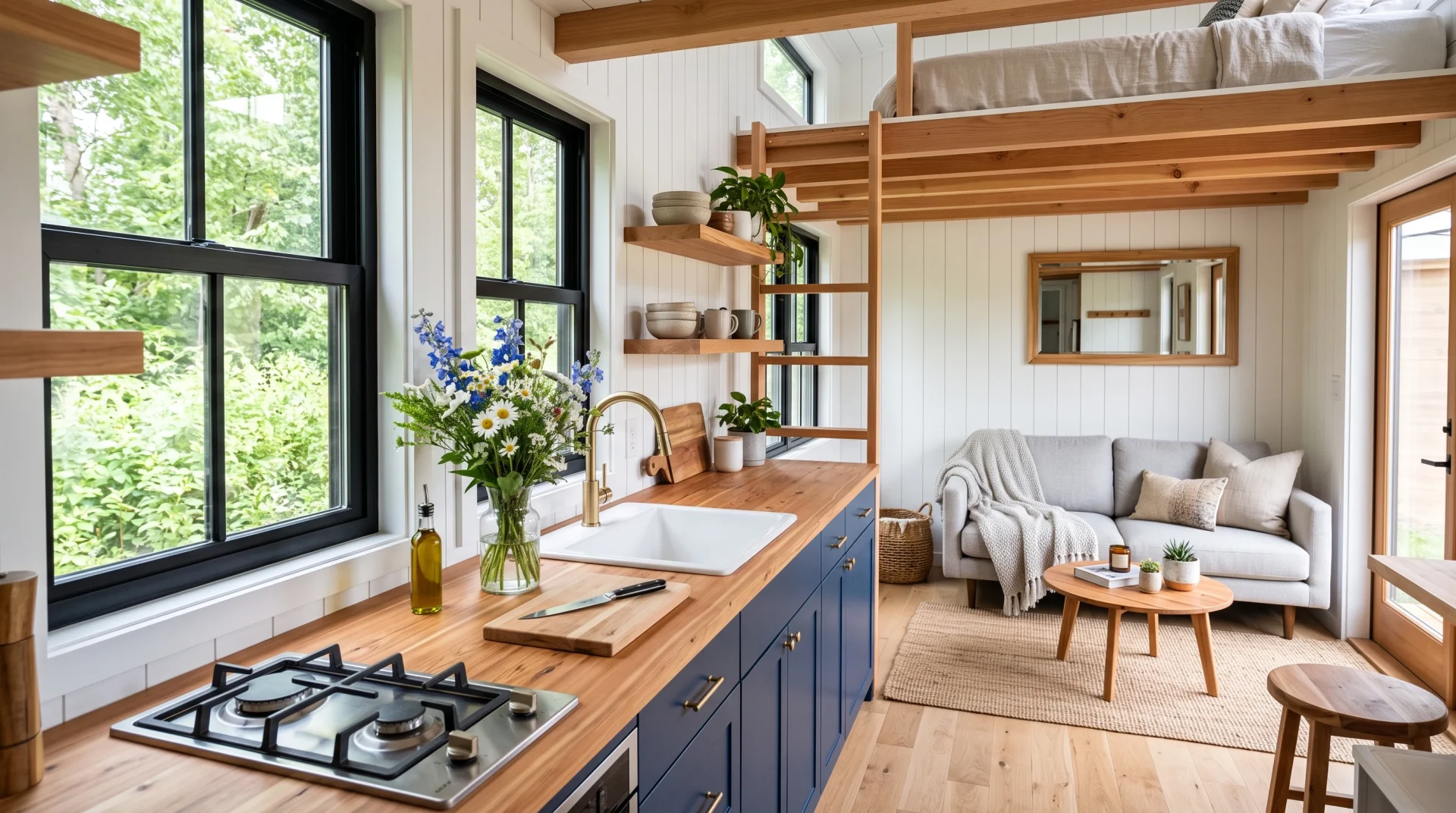
In a 250-square-foot dwelling, visual clutter is magnified exponentially. Remove all family photographs, pet accessories, excessive kitchen countertop appliances, and oversized clothing. Surfaces must appear expansive and spotless. Stage with neutral textiles, a small vase of fresh greenery, and ensure every built-in storage drawer opens smoothly without sticking.
5. Invest in Professional Real Estate Photography (24mm Focal Length)
Avoid using wide-angle “fisheye” smartphone settings that warp straight lines and curve ceilings. Hire a professional real estate photographer who shoots on a tripod at chest level using a 16mm to 24mm rectilinear full-frame lens. Capture daytime shots with all interior accent lights illuminated, as well as an exterior twilight (golden hour) hero photo that makes the home look magical and welcoming.
6. Price Methodically Based on Replacement Cost, Not Emotion
Emotional attachment often tempts DIY builders to overvalue their manual labor hours. The secondary market prices tiny homes strictly on component value, chassis condition, and square-foot utility. Study active comps on specialized portals. For a deeper understanding of market economics, consult our detailed analysis on how to sell a tiny house and our guide on flipping and reselling tiny homes.
7. Target High-Intent Micro-Dwelling Platforms
While Facebook Marketplace delivers high view counts, 90% of inquiries are casual browsers asking if the home is “still available.” Concentrate your primary marketing efforts on dedicated portals like Tiny House Listings, Tiny House Marketplace, and niche RV platforms. Explore our curated list of premier platforms in our tiny life website directory.
8. Pre-Service the Trailer Chassis, Tires, and Brakes
Nothing kills a walkthrough faster than rusted trailer tongue jacks, dry-rotted tires, or seized electric brakes. Prior to listing:
- Grease trailer wheel bearings and inspect brake pads.
- Replace any trailer tires older than 5 years, regardless of remaining tread depth.
- Test the emergency breakaway battery switch to ensure trailer brakes lock automatically if decoupled.
- Apply a fresh coat of rust-inhibiting black enamel paint to the trailer tongue and rear bumper.
9. Screen Remote Buyers Before Scheduling Walkthroughs
Tiny house sellers frequently suffer from “looky-loos”—curious neighbors who simply want a tour of a micro-home with zero intention of buying. Institute a mandatory screening protocol: require out-of-town buyers to provide proof of funds (bank statement snapshot) or a pre-approval letter from an RV lender before booking an in-person physical walkthrough.
10. Use Licensed Third-Party Escrow for Remote Settlement
Because buyers are frequently located hundreds of miles away, remote wire fraud and counterfeit cashier’s checks are serious risks. Never release title or allow a transport truck to couple to your trailer hitch until funds have fully cleared through a reputable online escrow provider (such as Escrow.com) or a local bank wire department.
Seller Due Diligence & Closing Checklist
| Milestone Stage | Mandatory Document / Item | Verification Action |
|---|---|---|
| Pre-Listing | State DMV Certificate of Title | Confirm 17-digit VIN matches trailer tongue stamp exactly |
| Marketing | Certified CAT Scale Weight Ticket | Verifies total trailer and tongue hitch weight |
| Inspection | PEX Pressure & Electrical Continuity Test | Confirms zero plumbing leaks and grounded circuits |
| Offer Acceptance | Signed Purchase Agreement & Escrow Deposit | Minimum 10% non-refundable deposit held in neutral escrow |
| Handover | Notarized Bill of Sale with As-Is Clause | Explicitly transfers towing liability upon coupling |
Frequently Asked Questions About Selling a Tiny House
What is the most common reason tiny houses fail to sell?
Overpricing and lack of financing eligibility are the primary reasons. If a custom tiny home lacks third-party certification (NOAH or RVIA), buyers must pay 100% cash. If priced identically to certified builds, uncertified homes will sit on the market for 6 to 12 months.
Should I offer delivery to help sell my tiny house?
Offering to coordinate delivery through a licensed, insured commercial transport company can significantly broaden your buyer pool. However, the buyer should always fund the transport expense ($3.50–$5.00 per loaded mile) directly to the hauling carrier.
Can I sell a tiny house that still has an active loan?
Yes. Contact your lienholder to obtain an official 10-day payoff quote. The buyer’s escrow funds are wired directly to your lender to satisfy the outstanding balance, after which the lender releases the title directly to the new owner.
Get our latest guides, news, and insights highlighted in your Google Search & AI Overviews.